
How to Avoid a Price War: 4 Strategies for Smarter Competition
01/20/2026 - Pricing strategy
In the competitive world of e-commerce, the temptation to lower prices to win a sale is constant. A competitor launches an aggressive offer, and the knee-jerk reaction is to match or even beat it. This impulse, while understandable, is the first step into a downward spiral that erodes profitability and brand value. The good news is that there’s a smarter, more sustainable alternative. Instead of reacting, you can lead with a proactive, data-driven pricing strategy designed to win without fighting a war of attrition.
"In today's e-commerce landscape, victory doesn't go to the cheapest seller, but to the one who understands the market most deeply. True competitiveness is born from data intelligence, not margin erosion."
— Antonio Tomás, CEO at Minderest & Reactev
What is a price war, and why is it a deadly trap for your profitability?
A price war is a market situation where competing companies progressively and aggressively lower their prices to capture or retain market share. What starts as a tactical move to gain visibility can quickly become a race to the bottom, where the only guaranteed loser is the profit margin of everyone involved.
The hidden costs: Margin erosion and brand devaluation
The most obvious impact of a price war is a direct hit to your P&L (Profit and Loss). Every discount eats into your margin. But the costs don't stop there. Constantly competing on being the cheapest severely damages the perceived value of your products. Customers start associating your brand with "cheap" instead of "quality" or "great service."
Furthermore, it sets a dangerous precedent: you train your customers to expect discounts. Once you've established a low price point, trying to raise it again is an uphill battle that can lead to strong resistance and the loss of customers who were only loyal to the price, not the brand.
Warning signs: Are you on the brink of a price war?
Identifying the early symptoms is key to taking action before it's too late. Pay attention to these signs:
- Aggressive competitor moves: One or more key competitors announce constant, not just one-off, price drops.
- Internal reaction is discount-driven: When sales dip, the first and only solution discussed internally is implementing across-the-board discounts.
- Shift in consumer behavior: You notice a significant increase in the use of online price comparison tools by users visiting your e-commerce site.
The strategic mistake of competing on price alone
In a transparent digital market, always trying to be the cheapest is an unsustainable strategy for most retailers. There will always be someone willing to operate on a thinner margin, whether it's a giant with economies of scale or a new competitor trying to make an aggressive market entry.
Using automated price matching without business rules to protect your profitability is like flying a plane without an altimeter: you're headed straight for the ground floor of your costs. Being competitive is not synonymous with being the cheapest. True competitiveness lies in offering the right price, for the right product, at the right time. Leading companies differentiate themselves through product quality, excellent customer service, and a superior shopping experience—not just by having the lowest price tag.
What is smart pricing?
Smart pricing is a strategy that uses data and technology, like artificial intelligence, to determine the optimal price for a product in real time. Instead of relying solely on costs or competitor prices, it considers variables like demand, stock levels, price elasticity, and customer behavior to maximize profitability.
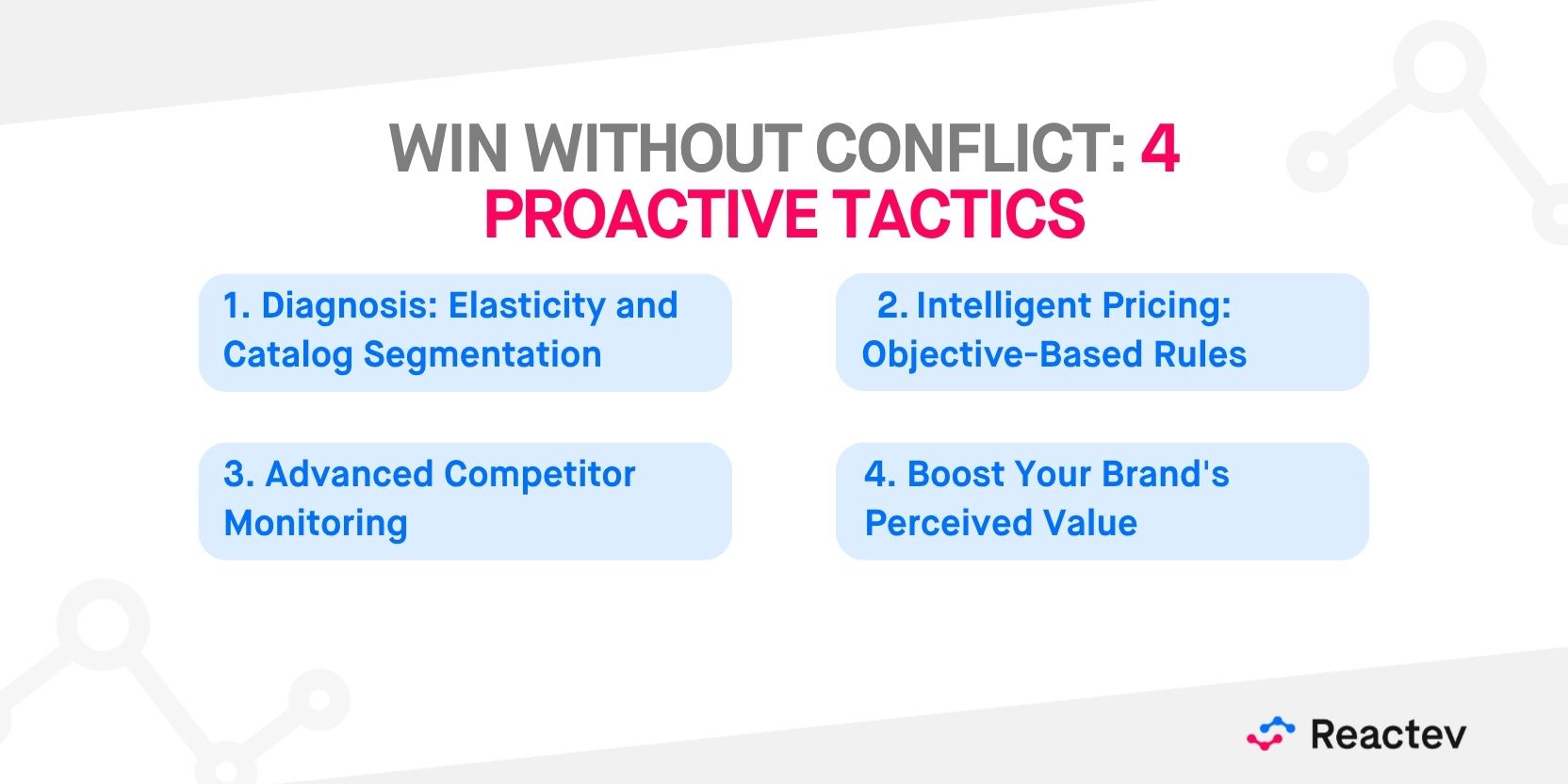
4 Proactive strategies to win without joining the battle
Shifting from a reactive mindset to a strategic approach is the only way to protect your margins and strengthen your market position. Here are four key strategies you can implement.
1. Catalog diagnosis: Demand elasticity and segmentation
Not all products in your catalog are created equal. The first step is to understand their strategic role. You need to identify your KVI (Key Value Items)—those that most influence your customers' price perception—as well as your destination products (the traffic drivers) and your margin builders (where your profitability lies). Using data to analyze demand elasticity will tell you which products can sustain a higher price without a drop in sales and which ones require you to be extremely competitive.
2. Define smart pricing rules based on your objectives
Once your catalog is segmented, it's time to set the rules of the game. This involves establishing non-negotiable profitability floors by product, category, or brand to protect your margins. Is your goal to maximize sales, gain market share, or optimize profit? Each objective requires a different pricing strategy.
Imagine a retailer moving from a simple rule like "always be $1 cheaper than competitor X" to a smart rule: "Match competitor X's price on the model A television (a KVI), but never go below a 15% margin. If our stock of that model drops below 5 units, increase the price to 5% above the competitor to maximize margin on the last units." This is the difference between reacting and strategizing—something that AI in pricing allows you to automate.
3. Advanced competitor monitoring
Monitoring your competition goes beyond just scraping their prices. Real competitive intelligence involves understanding their assortment strategy, stock levels, and pricing patterns. For example, with this visibility, you could detect that a competitor only drastically drops the price of a product when they have overstock. Instead of matching their low price, your strategy could be to hold yours, knowing their aggressive offer is temporary and your brand will allow you to keep selling when they run out of stock.
Discover how our Dynamic Pricing platform helps you implement these strategies. Request a demo.
4. Boost your brand's perceived value
Finally, remember that price is just one of many competitive levers. Invest in clearly communicating your differentiators: product quality, warranty, fast shipping, flexible returns, or exceptional customer service. A consistent and stable pricing strategy reinforces your brand image and builds trust that constant price drops can only destroy.
Practical Use Case: From a price war to profit optimization with Reactev
Scenario: A large electronics retailer is facing aggressive price cuts from a competitor in the smartphone category, one of their most important business segments.
The traditional reactive approach: The management team, alarmed by the potential loss of market share, decides to apply an across-the-board 10% discount on all smartphones to match the competitor. This move, while quick, sacrifices the margin of the entire category, including high-end products and accessories where they had a competitive advantage.
The strategic solution with Reactev:
- Catalog analysis: The platform analyzes the catalog and determines, based on historical sales data and elasticity, that only 5 smartphone models are truly price-sensitive (KVIs) for 80% of customers. These are the products consumers actively compare.
- Selective and automated pricing: A selective and automatic price matching strategy, defined by business rules, would be applied only to those 5 key models. This would maintain the perception of competitiveness on the products that really matter to the consumer.
- Optimization of the remaining catalog: For the rest of the smartphones (niche models, high-end devices, or those with high-margin accessories), the system would adjust prices dynamically based on demand, stock levels, and perceived value, even raising the price in some cases to maximize profit.
- Result: With this approach, the retailer could avoid a full-blown price war. They would protect their margins on the majority of the category, maintain a competitive price image where it's crucial, and optimize the profitability of the rest of their assortment.
For a deeper dive into how to apply this intelligence to your catalog, download our complete Dynamic Pricing Guide.
Frequently Asked Questions (FAQs) about Avoiding a Price War
Is lowering prices always a bad strategy?
Not necessarily. Tactical and controlled price drops can be effective for liquidating stock, launching a new product, or during specific promotional campaigns like Black Friday. The problem arises when price reduction becomes the only competitive strategy, used reactively and without a profitability analysis.
What is the first step to implementing a smart pricing strategy?
The first step is data analysis. You need to understand your own catalog (costs, margins, elasticity) and the market (competitor prices, stock levels, assortment). A price monitoring and optimization tool is essential for collecting and processing this information efficiently.
Is it very complicated to start using dynamic pricing software?
Modern solutions like Reactev are designed to integrate easily with major e-commerce platforms. The initial process focuses on defining your business objectives and pricing rules, so the technology can automate day-to-day tactical decisions and free up your team to focus on strategy.
From manual reaction to proactive pricing strategy
Abandoning a price war doesn't mean surrendering; it means starting to compete smarter. It involves shifting the focus from short-term reactions to building long-term, sustainable profitability.
According to a study by the Federal Trade Commission, "companies that adopt targeted and optimized pricing solutions using artificial intelligence achieve solid financial results, with an increase in profit margins of between 1% and 4% and revenue growth of between 2% and 5%."
With the right tools, you can simulate the impact of your strategies before launching them, make decisions based on thousands of data points, and ultimately, protect your brand and your bottom line in the competitive e-commerce environment.
Ready to leave price wars behind and start competing with a winning strategy? Talk to a Reactev expert.
Category: Pricing strategy