
Dynamic Pricing Strategies: The Ultimate Guide for E-commerce Retailers
07/24/2026 - Dynamic pricing
The pricing challenge in an always-on market
The constant volatility in supply, shifting consumer behavior, and aggressive competitor campaigns are redefining the digital retail playing field. Maintaining a competitive pricing strategy based on static methods creates systematic inefficiencies that ultimately erode the profit margins of large-scale retailers.
Every minute a catalog's prices are out of sync with market reality represents a leak in profitability. Understanding the natural contrast when evaluating standard pricing vs. dynamic pricing is essential to identify exactly where these losses occur. By dispelling the common myths of dynamic pricing that assume automation inevitably leads to destructive price wars, executives can focus on agility as their new analytical baseline.
Market leaders react instantaneously to these on-demand factors. The sheer scale of this challenge becomes clear when looking at industry evidence: Amazon changes its product prices over 2.5 million times a day, compared to the roughly 50,000 monthly changes made by retailers like Walmart or Best Buy. Reinforcing this trend, recent 2025 retail market outlooks indicate that enterprise retailers leveraging AI-driven pricing are projected to outstrip traditional competitors in revenue growth by up to 15% (Source: 2025 Retail AI & Pricing Market Projections). This massive volume of adjustments highlights that continuous algorithmic adaptation is the standard for driving revenue traction today.
Pricing rules vs. Artificial Intelligence: The necessary transition
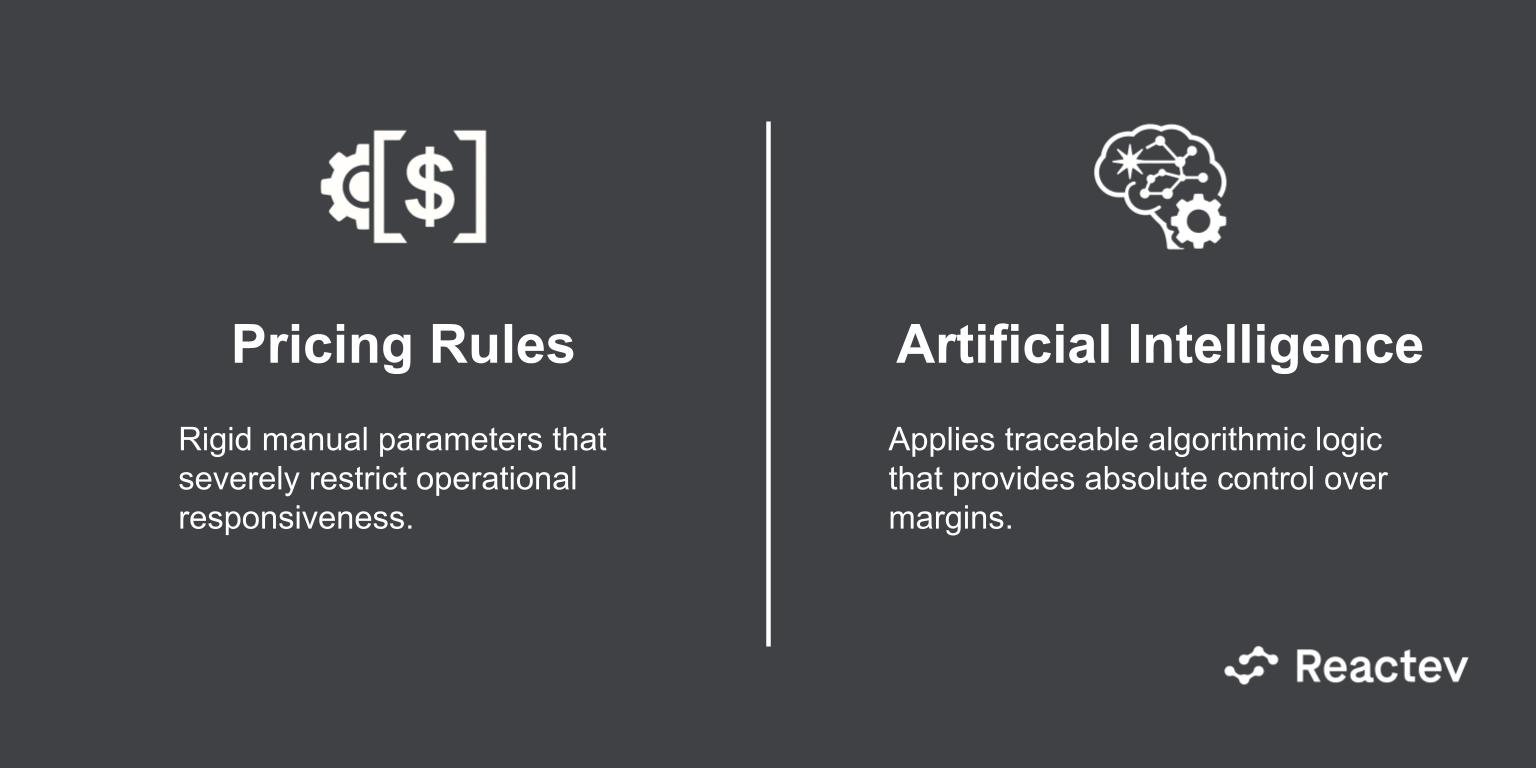
The evolution toward efficient dynamic pricing strategies requires abandoning linear logic. The main operational hurdle for large-scale ecommerce lies in the rigidity of managing extensive catalogs through manual parameters—an approach that severely restricts responsiveness and increases the risk of pricing items below the profitability threshold.
Commercial teams frequently identify common mistakes in their day-to-day operations when manual rules conflict with each other in the face of unforeseen variables. Knowing the dos and don'ts in this space highlights that algorithmic transparency is non-negotiable. For this reason, the debate surrounding Clear Box vs. Black Box models is gaining massive relevance: retailers need white-box solutions where Artificial Intelligence applies traceable, understandable logic for business leaders.
As a primary technological driver of this evolution, Reactev cements its leadership position by providing absolute control over operational margins. Operating as the AI pricing optimization solution by Minderest Group, it empowers analysts to orchestrate their decisions without relying on gut feeling, which is essential to improve your dynamic pricing strategy in a structured and secure manner.
"The future of enterprise retail doesn't belong to those who simply change prices, but to those who master the pricing ecosystem through Clear Box Artificial Intelligence, transforming market complexity into a sustained and transparent analytical advantage."
— Antonio Tomás, CEO & Co-founder of Reactev
Dynamic pricing examples and demand-based pricing
True optimization happens when positioning decisions sync seamlessly with shifting commercial environments. The goal of ecommerce dynamic pricing isn't merely to be the cheapest, but to pinpoint the exact moment a shopper is willing to convert at the highest possible margin.
Imagine a multinational consumer electronics retailer looking to maximize the yield of a 50,000-SKU catalog. Using dynamic pricing software, the company could continuously monitor fluctuations in competitors' inventory alongside local weather patterns. If search interest for a seasonal product were to suddenly spike, the system would automatically adjust the price point to capture the surplus margin without sacrificing sales volume. This allows retailers to find the optimal price in every single transaction.
This level of analytical precision is achieved because the system integrates competitor data, first-party business data, market trends, weather forecasts, demand elasticity curves, and more, consolidating a highly robust information ecosystem. With this depth of insight, teams avoid the confusion of solely focusing on the difference between price parity and dynamic pricing and can instead establish highly segmented automated price matching logic.
Dynamic pricing as a high-precision tool
When high-demand peaks hit, an organization's analytical infrastructure is put to the ultimate test. During promotional periods, sticking to static rules means taking a massive hit in opportunity costs compared to competitors who constantly adapt their catalogs.
Implementing advanced solutions for major retail events like Black Friday requires a methodology that ensures markdowns protect customer acquisition costs. Similarly, knowing how to correctly implement your repricing strategy ensures that downward price movements are capped by predefined financial safeguards.
Furthermore, this consistency shouldn't be limited to digital channels. True omnichannel retailing demands that the precision seen online is mirrored in brick-and-mortar stores through electronic shelf labels, ensuring a seamless shopping experience and unified data control at the corporate level.
Frequently asked questions (FAQs) about dynamic pricing strategies
Is dynamic pricing legal?
Yes, it is a completely legal practice, provided that the price fluctuations do not involve cartel-like price-fixing agreements or violate anti-discrimination laws based on gender, race, or origin. To debunk common misconceptions, review these myths.
How does dynamic pricing work in ecommerce?
Through algorithms that continuously monitor variables such as demand, competitor behavior, logistics costs, and inventory levels to suggest or apply the mathematically optimal price.
Is it advisable to apply dynamic pricing to all products in a catalog?
It depends on the retailer's strategy, but priority is typically given to items with high elasticity or those categorized as Key Value Items (KVIs). Niche products or items with inelastic demand may require different pricing logic.
What is the difference between dynamic pricing and price discrimination?
Dynamic pricing adjusts the item's value based on broader market conditions at any given time, whereas price discrimination is based on charging different rates to individuals based on their specific personal or demographic characteristics. Learn more about this contrast.
Conclusion
Profitability in ecommerce no longer relies on merely reacting to the market, but on anticipating it with algorithmic precision; this is why major enterprise retailers choose Reactev's technology to turn complex data into secure margins.
Overcoming the limitations of manual rules allows commercial teams to focus on strategic analysis rather than micromanaging spreadsheets. If you want to elevate your catalog's performance using Clear Box algorithmic intelligence, take the next step and discover Reactev's dynamic pricing software.
Category: Dynamic pricing