
AI-Based Dynamic Promotions for Ecommerce
03/23/2026 - Promotion optimization
In the fiercely competitive enterprise retail sector, applying blanket discounts is a tactic that slowly eats away at your profits. The solution to protecting margins without sacrificing sales volume lies in AI-based dynamic promotions for ecommerce. Through this approach, you will transform fragmented, manual processes into a robust strategy, achieving full-cycle response automation that optimizes every offer based on the real price elasticity of your products.
The End of Mass Discounting: Why Your Promotional Strategy Must Evolve
For years, static sale campaigns and universal promo codes worked well to drive traffic. However, in the enterprise retail landscape, this practice erodes commercial margins, fuels destructive price wars, and ultimately cheapens brand perception. Top-tier enterprise companies no longer need isolated creative ideas; they require mathematical precision and centralized strategic control.
The next evolutionary step is AI-driven promotion optimization. Leaving guesswork behind and embracing data science allows pricing managers to know exactly what percentage to discount, at what specific time, and which customer segment to target. This technology is no longer an early-stage innovation but an unavoidable competitive standard. In fact, according to projections by McKinsey, by 2025, 89% of retailers had already adopted some form of artificial intelligence in their operations. For the US and UK markets, this shift marks the definitive transition from seasonal discounting to continuous, data-driven margin protection.
"The true competitive advantage is no longer offering the steepest discount, but having the technological capability to know exactly what price to offer, to whom, and at what precise moment, always protecting corporate profitability." – Antonio Tomás, CEO of Reactev.
What Are AI-Based Dynamic Promotions?
What are AI-based dynamic promotions for ecommerce?
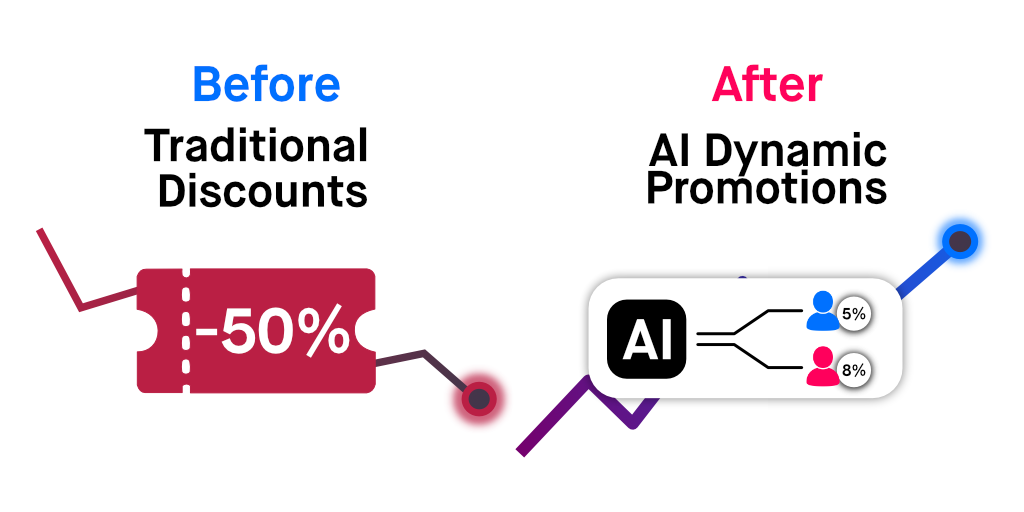
AI-based dynamic promotions for ecommerce are predictive systems that replace static offers with automated adjustments. The tool analyzes market behavior, predefined business rules, and demand elasticity to calculate the exact discount that guarantees the profitability of each transaction and protects your margins.
Unlike a traditional discount applied blindly across an entire catalog, using specialized software allows you to execute optimal promotions for every consumer. The urgency to adopt this model is evident across the industry; data from Research and Markets indicates that the dynamic pricing software market will reach $4 billion by 2026, growing at a CAGR of 14.7%, driven by the critical need to optimize revenue against fierce competition.
5 Dynamic Promotion Strategies to Maximize Sales and Profits
Implementing dynamic pricing for large-scale ecommerce requires tactics that leverage algorithmic potential without losing sight of financial goals. Below, we detail five fundamental approaches.
1. Smart Price Bundling
Bundling products is often an effective technique to increase the average order value, but doing it manually carries risks. By using AI, the system uncovers hidden purchasing affinities within historical data and creates highly profitable bundles that the user perceives as unique opportunities. To master this technique, we recommend reviewing these tips for implementing a price bundling strategy.
2. Discounts Adjusted by Demand Elasticity
Not all products react the same way to a price drop. Imagine a consumer electronics retailer: applying a 15% discount to a high-end TV with inelastic demand could mean an unnecessary loss of revenue if the customer was going to buy it anyway. In contrast, applying that same discount to high-turnover, highly elastic earbuds can drastically multiply sales volume. Varying the offer percentage based on elasticity allows you to design flawless profitable discount strategies.
3. Predictive Cross-Selling at Checkout
Online promotion personalization reaches its peak right before checkout. AI can analyze shopping cart contents in milliseconds and generate a highly attractive complementary offer. By anticipating user intent based on their previous browsing behavior, predictive cross-selling naturally increases the final conversion rate without adding friction.
4. Automated Flash Sales Based on Stock Levels
Holding dead stock generates high warehousing costs, but liquidating it at any price destroys your margin. Using an AI Pricing Engine, you can configure rules that trigger limited-time campaigns only when stock exceeds desired thresholds, gradually and controllably reducing prices until the warehouse is optimally cleared.
5. Real-Time Omnichannel Promotions
To remain competitive, it is vital that your store adapts its promotional strategy in response to broader market movements. Thanks to periodic competitor monitoring (processed daily or twice a day), algorithms can immediately adjust the offers visible across your sales channels. This ensures your commercial propositions are always the smartest choice for the consumer without crossing your profitability bottom line.
Discover how Reactev's promotion optimization software protects your margins while boosting your sales. Request a demo.
Practical Use Case: Optimizing an End-of-Season Campaign with Reactev
To understand the true impact of these technologies, imagine the scenario of a major fashion retailer facing a critical overstock in their winter coats category, needing to clear it urgently before introducing the new spring collection.
The traditional approach would be to apply a flat 30% discount across the entire category. While this would empty the warehouses, this manual measure would cause irreparable losses to profit margins, as it would discount items that are still selling at a healthy pace.
As a solution, the retailer decides to implement Reactev's price strategy simulation and optimization module. Instead of launching a mass sale, the AI analyzes sales history, the price elasticity of each SKU, and the exact volume of available stock. The system generates automated business rules that apply a mere 10% discount to the most in-demand coats, but go up to an aggressive 35% markdown on slower-moving sizes and colors that are at risk of becoming obsolete.
The result is definitive: the company successfully clears its target inventory while protecting the overall margin of the category. This entire process flows without constant manual intervention, featuring a substantial improvement in traffic conversions driven by AI-based decision-making.
The Importance of Simulating Your Promotions Before Launching Them
Predicting is better than reacting. Before activating any large-scale campaign, the Price Strategy Simulation feature allows pricing managers to visualize different "what-if" scenarios. This technology cross-references your acquisition costs, operational expenses, and historical market behavior to forecast the exact impact on revenue and profits.
With this data in hand, you can fine-tune key variables before risking real capital. Thoroughly understanding this testing phase will help you continuously implement successful and profitable promotions.
Frequently Asked Questions (FAQs) About AI-Based Dynamic Promotions for Ecommerce
How does artificial intelligence protect my profit margins?
The dynamic pricing system never works in the dark. All algorithms operate under strict business rules preconfigured by your team, guaranteeing that no automated markdown undercuts the base cost or the minimum acceptable profit margin for the company.
How often are competitor prices adjusted in the dynamic model?
At a strategic and B2B level, competitor monitoring and price recommendations are periodic processes (usually daily or twice a day). This brings stability to the system and allows you to automate efficient workflows, avoiding the chaotic fluctuations of pure real-time pricing.
What happens with new products that have no sales history?
For new SKUs where there is not yet a "match" with the competition nor an elasticity history, recommendations are initially based on your corporate business rules (cost/margin ratio). Once the product generates engagement, market-based optimization kicks in as a second analytical step.
The Future of Enterprise Ecommerce is Predictive
The transition from manual reaction to a proactive strategy is already defining leaders in the retail sector. Today's consumers respond exponentially better to personalized, optimized shopping experiences. In fact, reports from Adobe Analytics show that during the 2025 holiday shopping season, traffic driven by generative AI on retail sites grew by a staggering 693% year-over-year. Even more revealing: AI-referred traffic converted 31% higher than other sources, reducing bounce rates by 27%.
Integrating advanced retail promotion software transforms fragmented processes into relentless analytical control. To thrive, it is vital to let technology handle the operational heavy lifting while your team focuses on the overarching global strategy.
Elevate your pricing strategy and ensure the profitability of every campaign. Discover the our Promotion Optimization Software today.
Category: Promotion optimization