Discount Optimization: The AI Formula for a Profitable Strategy
12/11/2025 - Price optimization
Many e-commerce managers believe there’s no magic formula for the perfect discount. They think it's a mix of intuition, trial and error, and reacting to competitors. But they're mistaken. The formula exists; it’s just not a simple equation, but a complex artificial intelligence model capable of analyzing thousands of variables. True discount optimization isn't about finding the ideal percentage for one product, but about designing an intelligent promotion system that maximizes your business's overall profitability.
What Does Discount Optimization Really Mean for an Enterprise Retailer?
In the competitive retail landscape, it's easy to confuse "applying a discount" with "optimizing a promotion." The first is a tactical, isolated action: lowering a product's price to stimulate sales. The second is a strategic process that considers the impact of that action on the entire business ecosystem.
Real optimization goes beyond price and volume, analyzing complex variables such as:
- Product Cannibalization: Is the promotion on a mid-range laptop stealing sales from the new high-end model that has a higher margin?
- Halo Effect: Is the discount on a "loss leader" product driving the purchase of other full-price items in the same shopping cart?
- Cross-Price Elasticity: How does a price drop on one coffee brand affect the demand for other competing brands in your catalog?
- Customer Lifetime Value (LTV): Is the promotion attracting bargain hunters who will never return, or new, loyal customers with high potential LTV?
The ultimate goal isn't just to move units of a specific SKU. It's to maximize the total margin and sales volume of the business, understanding each promotion as a piece of a much larger strategic puzzle.
Common Discount Management Mistakes Costing Millions
A promotion management strategy based on intuition or simplistic rules often leads to the silent erosion of margins. These are some of the most frequent and costly mistakes:
- Blanket Discounts: Applying a "20% off sitewide" promotion is one of the most dangerous practices. Imagine a fashion retailer using this rule. Products with very high demand and low price sensitivity, like an iconic handbag, are sold at an unnecessary discount, giving away margin. Meanwhile, slow-moving products might have needed a 30% discount to sell, making the 20% discount ineffective.
- Basing Promotions Solely on Competitor Actions: Reacting to a competitor's price drop without analyzing your own stock, costs, and brand positioning can trigger a destructive price war for everyone involved.
- Ignoring Logistics and Inventory Costs: A successful promotion that causes a demand spike can overwhelm your logistics or deplete the stock of complementary products, leading to a poor customer experience and lost future sales.
- Failure to Measure True ROI: Many companies measure success by the increase in units sold, without calculating the campaign's actual net margin, the customer acquisition cost, and the impact on sales of other products.
"The biggest risk in pricing isn’t getting one discount wrong; it’s perpetuating a promotion system based on intuition. Technology today allows us to transform the art of the deal into an exact science that protects margins and drives growth."
- Antonio Tomás, CEO at Minderest & Reactev.
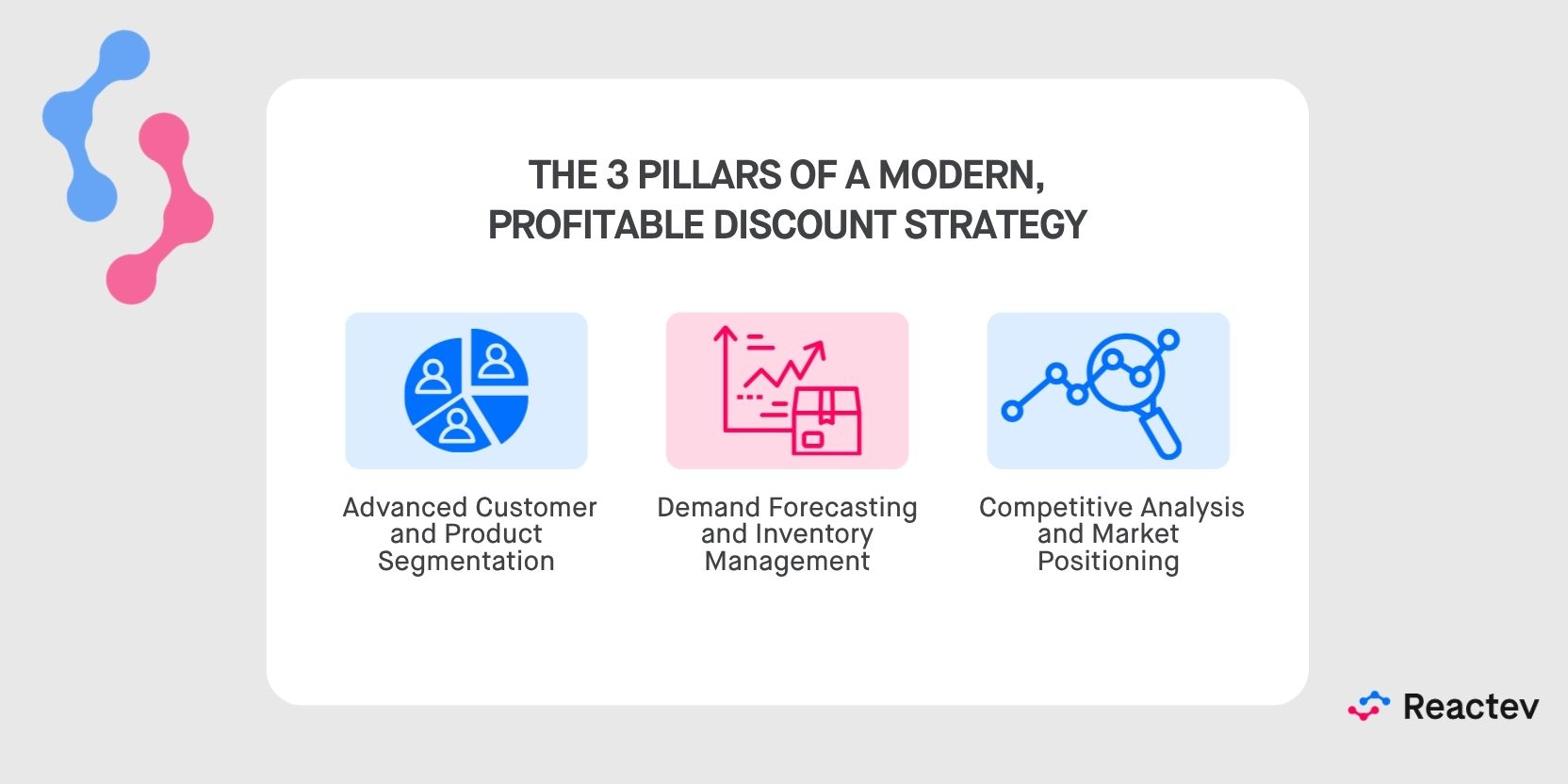
The 3 Pillars of a Modern, Profitable Discount Strategy
To move from reactive promotions to intelligent discounts, your strategy must be built on three fundamental pillars that AI technology can automate and scale.
Advanced Customer and Product Segmentation
Not all products and customers are created equal. A modern strategy must identify which products act as traffic drivers and which are margin generators that need to be protected. Similarly, it's crucial to tailor discounts to the price sensitivity of each customer segment. As a study by McKinsey & Company indicates, personalization can drive revenue increases of up to 15%, proving the power of treating each customer uniquely.
Demand Forecasting and Inventory Management
AI allows you to get one step ahead. Instead of reacting to excess inventory, predictive models can anticipate how a promotion will impact future demand for that product and related items. This enables you to adjust purchasing levels and logistics to support the campaign without stockouts or extra costs. An advanced pricing engine is key to executing these estimates with precision and reliability.
Competitive Analysis and Market Positioning
Knowing what your competitors are doing is important, but reacting intelligently is crucial. Discount optimization analyzes the competitive environment to understand how a promotion will affect your brand perception. Sometimes, the best response to a competitor's aggressive campaign isn't to match their price, but to reinforce the unique value of your offer or promote alternative products with higher margins.
Practical Use Case: Optimizing a "Back to School" Campaign
Let's see how an optimization platform can transform a tactical campaign into a profitable strategy.
- Scenario: A large electronics retailer wants to clear out last year's laptop models to make room for new ones but fears cannibalizing sales of the new models, which have a higher margin.
- Strategic Goal: Maximize total revenue in the "laptops" category and reduce inventory of 5 specific SKUs within four weeks.
- Execution with Optimization Software:
- Instead of manually applying a 15% or 20% discount, the promotion optimization module would use historical sales data, elasticity, and market data to simulate the impact of different discount levels.
- The system could predict the level of cannibalization on the new models for each scenario. It might reveal that a discount greater than 18% on the old models causes a drastic drop in sales for the new ones, destroying overall margin.
- Based on this simulation, the platform could suggest a combined strategy: an optimal 17% discount on the models to be cleared, along with a bundle offer (laptop + high-margin mouse) to protect the cart's profitability.
- The expected result would be a much more efficient stock clearance, minimizing predicted cannibalization and protecting—or even increasing—the category's overall margin.
Technology as a Catalyst: How AI Executes Optimization at Scale
Performing this level of analysis for thousands of SKUs is humanly impossible. This is where technology becomes the engine of change.
- The Role of Machine Learning: Algorithms analyze thousands of internal variables (stock, costs, historical sales) and external ones (competitor prices, seasonality, demand trends) for each product in seconds.
- Automation of Complex Rules: This allows you to set up smart workflows like: "If stock for product X drops below 20% and its margin remains above 35%, adjust the promotion on related product Y to maximize the total cart value."
- Scenario Simulation: The ability to simulate scenarios is perhaps the greatest value. Before risking a single dollar, e-commerce managers can compare the projected outcomes of different promotional strategies (e.g., "Buy One, Get One 50% Off" vs. "3 for 2" vs. a "20% direct discount") and choose the one with the highest expected profitability.
Discover how our promotion optimization software automates these complex decisions to maximize your profitability.
What is smart discount optimization?
Smart discount optimization is a strategic approach that uses AI and Machine Learning technology to define the best promotional tactic. Unlike applying a fixed percentage, it analyzes variables like demand elasticity, inventory, costs, cannibalization, and competitor actions to recommend the discount that maximizes the business's overall profitability, not just the sales of a single product.
Frequently Asked Questions (FAQs) about Discount Optimization
How does optimization work for new products with no historical data?
For new products, AI models use product attributes (category, brand, features) to find "look-alike products" with sales histories. Initially, recommendations are based on these similar products and business rules (cost + target margin). The system then learns and adjusts as the first sales data comes in.
Is this technology only for large retailers with thousands of products?
While the complexity and benefits increase with the size of the catalog, the principles of optimization are valid for any e-commerce business looking to maximize its profitability. The key isn't the number of SKUs, but the commitment to shift from an intuition-based decision model to a data-driven one.
Does automating promotions eliminate the need for a pricing team?
On the contrary, it empowers them. The technology handles massive data analysis and repetitive tasks, freeing up the pricing team to focus on strategy: defining business goals, monitoring campaign performance, analyzing brand positioning, and making high-level creative decisions that AI cannot replicate.
From Intuition to Intelligence: The Future of Promotions
Discount management in e-commerce has reached a turning point. Continuing to rely on spreadsheets, manual rules, and impulsive reactions is no longer sustainable or profitable. AI-powered promotion optimization allows retailers to transform one of their biggest cost drivers into a powerful engine for strategic growth.
The true competitive advantage no longer lies in offering the biggest discount, but in applying the smartest one. This leads to higher profitability, reduced excess inventory, and, most importantly, the confidence to make business decisions backed by data, not guesswork. It is the definitive step from a reactive strategy to a proactive and predictive one.
Ready to stop guessing the ideal discount? Request a demo of our Promotion Optimization platform.
Category: Price optimization